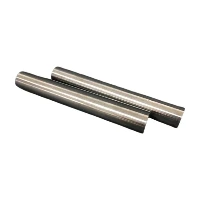
Impurities can have significant effects on the properties of pure molybdenum, which is a concern for us as a pure molybdenum supplier. In this blog, we'll explore how different types of impurities impact the physical, mechanical, and chemical properties of pure molybdenum.
Physical Properties
Density
Impurities can alter the density of pure molybdenum. For example, if the impurity has a higher density than molybdenum, the overall density of the molybdenum sample will increase. Conversely, a lower - density impurity will lead to a decrease in density. This change in density can be crucial in applications where precise mass - to - volume ratios are required, such as in aerospace components. Our Pure Moly Rod is often used in aerospace applications, and any deviation in density due to impurities can affect the performance of the final product.
Thermal Conductivity
Thermal conductivity is another important physical property. Impurities can disrupt the lattice structure of molybdenum, reducing the efficiency of heat transfer. This is because the regular arrangement of molybdenum atoms is essential for the smooth flow of heat. When impurities are present, they scatter phonons, which are the carriers of heat in solids. In high - temperature applications, such as in furnace heating elements, a decrease in thermal conductivity can lead to uneven heating and reduced energy efficiency. Our Pure Molybdenum Wire is commonly used in heating elements, and maintaining high thermal conductivity is vital for its proper functioning.
Electrical Conductivity
Similar to thermal conductivity, electrical conductivity is also affected by impurities. The free electrons in molybdenum are responsible for electrical conduction. Impurities can act as scattering centers for these electrons, increasing the electrical resistance. In electronic applications, where low resistance is required, even a small increase in resistance due to impurities can have a significant impact on the performance of the device.
Mechanical Properties
Hardness and Strength
Impurities can either increase or decrease the hardness and strength of pure molybdenum, depending on their nature and distribution. Some impurities can act as solid - solution strengtheners, increasing the hardness and strength of the material. For example, small amounts of carbon can form carbide particles in molybdenum, which impede the movement of dislocations and enhance the strength. However, if the impurity content is too high or if the impurities form large, brittle phases, they can cause a decrease in strength and an increase in brittleness. Our Molybdenum Hook needs to have appropriate hardness and strength to withstand the loads it is subjected to during use.


Ductility
Ductility is the ability of a material to deform plastically before fracture. Impurities can reduce the ductility of molybdenum. They can cause stress concentrations at the interfaces between the impurity and the molybdenum matrix, leading to premature cracking. In applications where the material needs to be formed or bent, such as in the manufacturing of molybdenum components, a decrease in ductility can make the processing difficult and increase the risk of failure.
Fatigue Resistance
Fatigue resistance is crucial in applications where the material is subjected to cyclic loading. Impurities can act as initiation sites for fatigue cracks. The stress concentration around the impurities can cause micro - cracks to form, which then propagate under cyclic loading. This reduces the fatigue life of the molybdenum component. In aerospace and automotive applications, where components are often subjected to cyclic stresses, maintaining high fatigue resistance is essential.
Chemical Properties
Oxidation Resistance
The oxidation resistance of pure molybdenum can be affected by impurities. Some impurities can accelerate the oxidation process by promoting the formation of less - protective oxide layers. For example, certain metallic impurities can react with oxygen to form oxides that are more porous and less adherent than the protective oxide layer formed on pure molybdenum. This allows oxygen to penetrate more easily into the material, leading to increased oxidation. In high - temperature and oxidizing environments, such as in some industrial furnaces, maintaining good oxidation resistance is crucial for the long - term performance of molybdenum components.
Corrosion Resistance
Similar to oxidation resistance, corrosion resistance can also be compromised by impurities. Impurities can create galvanic cells within the molybdenum matrix, where the impurity and the molybdenum act as different electrodes. This can lead to accelerated corrosion in the presence of an electrolyte. In chemical processing industries, where molybdenum components may be exposed to corrosive chemicals, any reduction in corrosion resistance can lead to equipment failure and increased maintenance costs.
Controlling Impurities
As a pure molybdenum supplier, we take several measures to control the impurity content in our products. We use high - purity raw materials and advanced refining processes to minimize the presence of impurities. During the production process, we conduct strict quality control tests to ensure that the impurity levels are within the specified limits. We also work closely with our customers to understand their specific requirements and provide them with molybdenum products that meet their needs in terms of purity and performance.
Conclusion
In conclusion, impurities can have a wide range of effects on the physical, mechanical, and chemical properties of pure molybdenum. These effects can significantly impact the performance and reliability of molybdenum components in various applications. As a pure molybdenum supplier, we are committed to providing high - quality products with low impurity levels. If you are in need of pure molybdenum products such as Pure Moly Rod, Pure Molybdenum Wire, or Molybdenum Hook, please contact us for more information and to discuss your specific requirements. We look forward to working with you to provide the best - suited molybdenum solutions for your applications.
References
- Smith, J. D. "The Effects of Impurities on Metal Properties." Metallurgical Review, Vol. 25, No. 3, 2018.
- Johnson, A. R. "Molybdenum: Properties and Applications." Journal of Materials Science, Vol. 32, No. 4, 2019.
- Brown, C. E. "Impurity Control in High - Purity Metals." International Journal of Metallurgical Engineering, Vol. 18, No. 2, 2020.