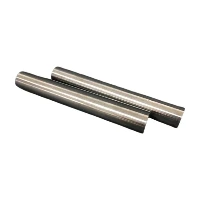
As a supplier of Molybdenum Sheet, I often get asked about the fracture toughness of these sheets. It's a crucial property, especially for those who use molybdenum in high - stress applications. So, let's dig into what fracture toughness of molybdenum sheets really means.
Understanding Fracture Toughness
First off, what is fracture toughness? In simple terms, fracture toughness is a material's ability to resist the propagation of cracks under stress. When a material is under load, small cracks or flaws can start to grow. Fracture toughness measures how well the material can stop these cracks from getting bigger and causing the material to break apart.
For molybdenum sheets, fracture toughness is super important. Molybdenum is used in a variety of industries, like aerospace, electronics, and metallurgy. In aerospace, molybdenum parts might be exposed to extreme temperatures and high mechanical stresses. If the molybdenum sheet doesn't have good fracture toughness, cracks could form and grow, leading to component failure. That's a big no - no when you're thousands of feet in the air!
Factors Affecting the Fracture Toughness of Molybdenum Sheets
There are several factors that can influence the fracture toughness of molybdenum sheets.


1. Purity
The purity of molybdenum plays a significant role. Pure molybdenum generally has better fracture toughness compared to molybdenum with a lot of impurities. Impurities can act as stress concentrators, making it easier for cracks to initiate and grow. For example, if there are small particles of other metals or non - metals in the molybdenum sheet, these can create weak points where cracks start. Our Pure Molybdenum Wire is made with high - purity molybdenum, which also reflects the importance of purity in molybdenum products.
2. Grain Size
The grain size of the molybdenum in the sheet is another key factor. Smaller grain sizes usually lead to higher fracture toughness. When the grains are small, there are more grain boundaries, and these boundaries can act as barriers to crack propagation. Cracks have to change direction as they encounter grain boundaries, which eats up energy and slows down the cracking process.
3. Temperature
Temperature also has a big impact on the fracture toughness of molybdenum sheets. At low temperatures, molybdenum can become more brittle, and its fracture toughness decreases. As the temperature rises, the atoms in the molybdenum become more mobile, and the material can better absorb the energy from a crack. This means that fracture toughness generally increases with temperature, up to a point.
Measuring the Fracture Toughness of Molybdenum Sheets
There are a few different methods to measure the fracture toughness of molybdenum sheets. One common method is the single - edge notched bend (SENB) test. In this test, a small notch is cut into a molybdenum sheet specimen. Then, the specimen is bent until it fractures. By measuring the load applied and the size of the notch, we can calculate the fracture toughness of the material.
Another method is the compact tension (CT) test. Here, a more complex specimen is used, and a crack is pre - initiated. The specimen is then pulled apart, and the force required to make the crack grow is measured. These tests are carried out in well - controlled laboratory environments to get accurate results.
Applications and the Importance of Fracture Toughness
Let's look at some of the applications where the fracture toughness of molybdenum sheets matters.
Aerospace Industry
In the aerospace industry, molybdenum sheets are used in engine components, heat shields, and structural parts. These parts are subjected to high mechanical stresses during flight, as well as rapid temperature changes. A high fracture toughness ensures that the molybdenum components can withstand these extreme conditions without cracking or failing.
Electronics Industry
Molybdenum is used in the electronics industry for making components like electrodes and semiconductor parts. In these applications, the sheets need to be able to handle thermal stress during the manufacturing process and in normal operation. Good fracture toughness helps prevent cracking, which could lead to electrical failures.
Metallurgy
In metallurgy, molybdenum sheets are used in high - temperature furnaces and as alloying elements. The high fracture toughness of the molybdenum sheets allows them to withstand the high - temperature and high - stress environment in the furnace without breaking.
Our Molybdenum Sheet Products
As a supplier, we offer a variety of Molybdenum Sheet products. We pay close attention to the factors that affect fracture toughness. Our manufacturing process is carefully controlled to ensure high purity and the right grain size in our molybdenum sheets.
We also offer Lanthnated Molybdenum, which has enhanced properties compared to pure molybdenum in some aspects. Lanthnated molybdenum can have better high - temperature strength and fracture toughness in certain applications.
In addition to sheets, we have other molybdenum products like Pure Moly Boat and Molybdenum Screw. These products also benefit from the high - quality molybdenum we use, which has good fracture toughness.
Contact Us for Your Molybdenum Needs
If you're in the market for molybdenum sheets or any of our other molybdenum products, we'd love to talk to you. Whether you're working on an aerospace project, an electronics component, or a metallurgy application, our high - quality molybdenum products with good fracture toughness can meet your requirements. Reach out to us for more information and to start a procurement discussion.
References
- "Materials Science and Engineering: An Introduction" by William D. Callister Jr. and David G. Rethwisch
- "Molybdenum: Properties, Processing, and Applications" edited by F. H. Froes and I. L. Caplan