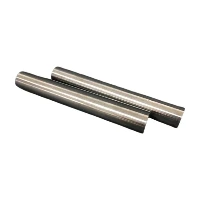
What is the roundness tolerance of a pure moly rod?
As a supplier of pure moly rods, I often encounter inquiries from customers regarding the roundness tolerance of these products. Roundness tolerance is a crucial factor in determining the quality and suitability of a pure moly rod for specific applications. In this blog post, I will delve into the concept of roundness tolerance, its significance in the context of pure moly rods, and the factors that influence it.
Understanding Roundness Tolerance
Roundness, also known as circularity, refers to the condition of a cross - section of a cylindrical object, such as a rod, being a perfect circle. In reality, achieving a perfectly circular cross - section is almost impossible due to various manufacturing limitations. Roundness tolerance is the allowable deviation from a perfect circular shape. It is defined as the maximum and minimum values of the radial distance from the center of the ideal circle to the actual surface of the rod within a specified cross - section.


For example, if a pure moly rod has a nominal diameter of 10 mm and a roundness tolerance of ±0.01 mm, it means that at any cross - section of the rod, the actual radius of the rod can vary between 4.99 mm and 5.01 mm from the center of the ideal circle.
Significance of Roundness Tolerance in Pure Moly Rods
Pure moly rods are widely used in various industries, including aerospace, electronics, and metallurgy, due to their excellent high - temperature strength, corrosion resistance, and good electrical conductivity. The roundness tolerance of these rods plays a vital role in their performance in these applications.
In aerospace applications, pure moly rods are used in engine components and structural parts. A tight roundness tolerance ensures a proper fit and alignment of these components, which is essential for the safe and efficient operation of the aircraft. Even a small deviation in roundness can lead to uneven stress distribution, vibration, and premature failure of the parts.
In the electronics industry, pure moly rods are used as electrodes and heating elements. Precise roundness is necessary to ensure uniform electrical and thermal conductivity. Any irregularity in the roundness can cause hot spots, which may damage the electronic devices and reduce their lifespan. For more information on molybdenum heating elements, you can visit Molybdenum Heating Element.
In metallurgy, pure moly rods are used as additives in alloy production. The roundness of the rods affects their melting behavior and the homogeneity of the alloy. A well - rounded rod will melt more evenly, resulting in a more consistent alloy composition.
Factors Influencing Roundness Tolerance
Several factors can influence the roundness tolerance of pure moly rods during the manufacturing process.
Raw Material Quality: The quality of the raw molybdenum used to produce the rods is a fundamental factor. Impurities in the raw material can cause inhomogeneous deformation during the forming process, leading to variations in roundness. High - purity molybdenum with a uniform grain structure is more likely to produce rods with better roundness.
Manufacturing Process: The method used to manufacture the pure moly rods has a significant impact on roundness tolerance. Common manufacturing processes include extrusion, forging, and machining.
Extrusion is a process where the molybdenum billet is forced through a die to form a rod. The quality of the die, the extrusion speed, and the temperature control during extrusion can all affect the roundness of the rod. A well - designed die with precise dimensions and smooth surfaces can help achieve a better roundness tolerance.
Forging involves shaping the molybdenum by applying compressive forces. The forging equipment, the number of forging passes, and the forging temperature can influence the roundness. Improper forging can cause uneven deformation and result in a rod with poor roundness.
Machining, such as turning or grinding, is often used to achieve the final dimensions and roundness of the rod. The accuracy of the machining equipment, the cutting tools, and the machining parameters (such as cutting speed, feed rate, and depth of cut) are critical factors. A high - precision machining center with sharp cutting tools and proper parameter settings can produce rods with tight roundness tolerances.
Heat Treatment: Heat treatment is an important step in the manufacturing of pure moly rods to improve their mechanical properties. However, if the heat treatment process is not properly controlled, it can cause thermal stress and distortion, which may affect the roundness of the rod. Uniform heating and cooling rates, as well as appropriate heat treatment temperatures, are necessary to maintain the roundness.
Measuring Roundness Tolerance
There are several methods available to measure the roundness tolerance of pure moly rods. One of the most common methods is using a roundness measuring instrument, such as a roundness tester. This instrument works by rotating the rod while a probe measures the radial distance from the center of the rod at multiple points around the circumference. The data collected is then analyzed to determine the roundness deviation.
Another method is the use of coordinate measuring machines (CMMs). CMMs can measure the three - dimensional coordinates of points on the surface of the rod. By analyzing these coordinates, the roundness of the rod can be calculated.
Controlling Roundness Tolerance in Production
As a supplier of pure moly rods, we take several measures to control the roundness tolerance in our production process.
We source high - quality raw molybdenum from reliable suppliers to ensure a uniform starting material. Our manufacturing processes are carefully designed and optimized. For example, we use advanced die - making technology to produce dies with high precision for extrusion. In machining, we regularly calibrate our equipment and use high - quality cutting tools to ensure accurate and consistent results.
During the heat treatment process, we use state - of - the - art furnaces with precise temperature control systems to minimize thermal stress and distortion. We also implement a strict quality control system at every stage of production. Each rod is inspected using roundness measuring instruments to ensure that it meets the specified roundness tolerance.
Conclusion
In conclusion, the roundness tolerance of a pure moly rod is a critical parameter that affects its performance in various applications. It is influenced by factors such as raw material quality, manufacturing process, and heat treatment. As a supplier, we are committed to providing pure moly rods with tight roundness tolerances to meet the high - quality requirements of our customers.
If you are in need of high - quality pure moly rods, we invite you to contact us for procurement and further discussions. Our team of experts is ready to assist you in selecting the right products for your specific applications. We also offer other molybdenum products such as Molybdenum Bar and Molybdenum Sheet.
References
- ASM Handbook Volume 2: Properties and Selection: Nonferrous Alloys and Special - Purpose Materials
- "Manufacturing Engineering and Technology" by S. Kalpakjian and S. Schmid
- Industry standards for molybdenum products from relevant professional organizations.